
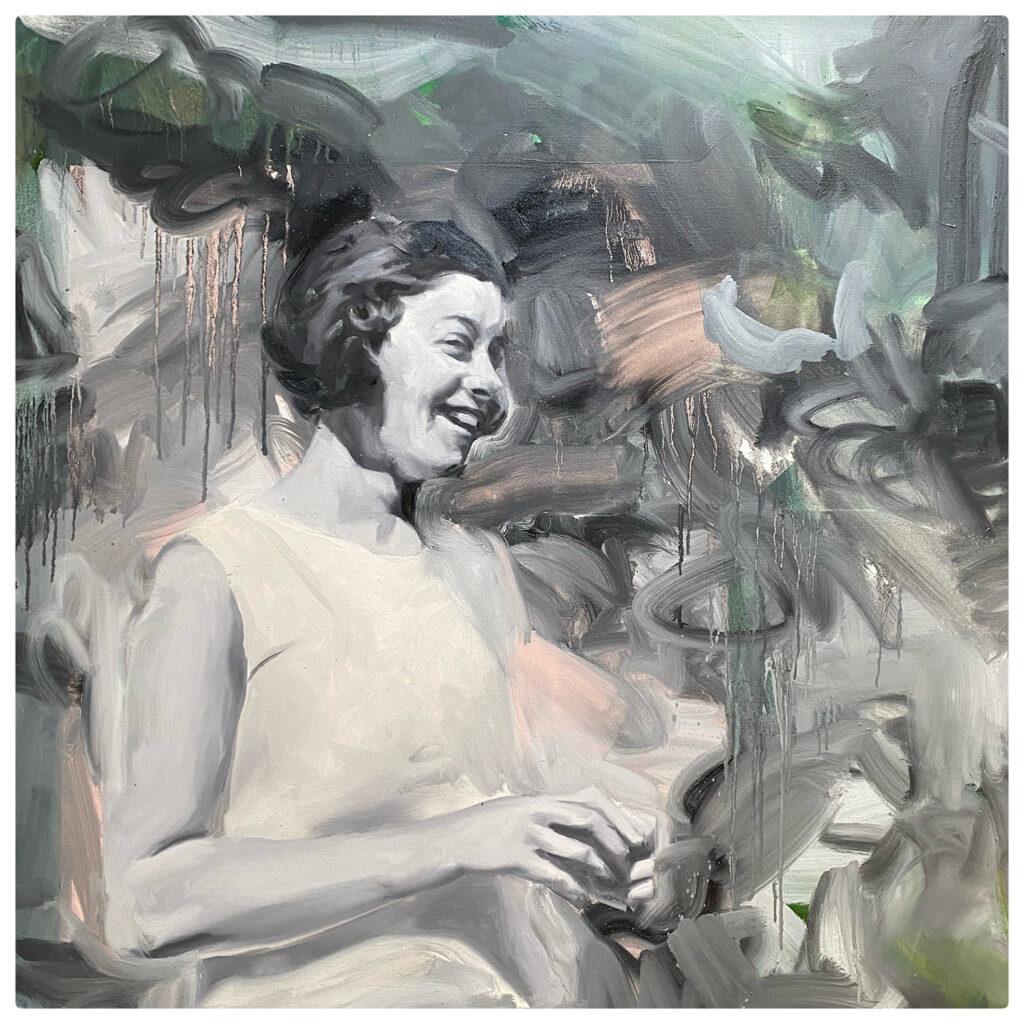
Nick Hersey’s artwork, as exemplified by the piece you’ve shared, is a compelling exploration of the individual’s struggle within a consumerist society, while also reflecting the surreal and labyrinthine influences of J.L. Borges. The painting blends figurative and abstract elements, creating a visual narrative that mirrors the artist’s thematic preoccupations with identity, alienation, and the overwhelming complexity of modern life—ideas that resonate deeply with both consumerism and Borges’ literary universe.
The central figure, a woman in a simple white dress, appears grounded yet isolated amidst a chaotic swirl of abstract brushstrokes. This juxtaposition suggests the individual’s attempt to maintain a sense of self in the face of a consumerist society that often commodifies and fragments personal identity. Her serene expression and delicate posture contrast sharply with the turbulent, dripping background, which could symbolize the relentless onslaught of advertising, media, and material desires that Hersey critiques. The muted palette—grays, greens, and subtle pinks—further enhances this tension, evoking a sense of being submerged in a world where individuality is diluted by mass production and consumption.
Hersey’s interest in Borges is evident in the painting’s dreamlike, almost metaphysical quality. Borges’ works, such as The Library of Babel or The Garden of Forking Paths, often explore infinite possibilities, fragmented realities, and the blurring of boundaries between the real and the imagined. The abstract elements here—swirling forms and dripping paint—can be seen as a visual echo of Borges’ labyrinths, where meaning is elusive and the individual is lost in an endless web of signs and symbols. The woman’s hands, delicately poised as if holding or shaping something, might allude to the futile search for agency or truth within this maze, a theme Borges frequently revisits. The composition’s lack of clear spatial orientation reinforces this disorientation, suggesting a consumerist society where traditional markers of value and identity are destabilized.
Technically, Hersey employs a bold, expressive style with thick, textured strokes that convey emotional intensity. The drips and smears could be interpreted as the residue of a society in flux, where the individual is both creator and victim of its excesses. However, this approach risks overwhelming the figure, potentially reducing her presence to a mere anchor in the chaos rather than a fully realized subject. The balance between abstraction and representation feels precarious—while it effectively mirrors the disarray of consumerism, it might leave some viewers struggling to connect with the human element Hersey seems to champion.
Overall, this artwork succeeds as a critique of consumerist society by portraying the individual as both resilient and overwhelmed, a duality that aligns with Hersey’s thematic focus. The Borges influence adds a layer of intellectual depth, inviting viewers to ponder the infinite loops and illusions of modern life. Yet, the piece might benefit from a slightly clearer delineation of the figure to strengthen the narrative of personal struggle against the backdrop of societal chaos. It stands as a striking visual meditation, challenging us to navigate the labyrinth of our own making.